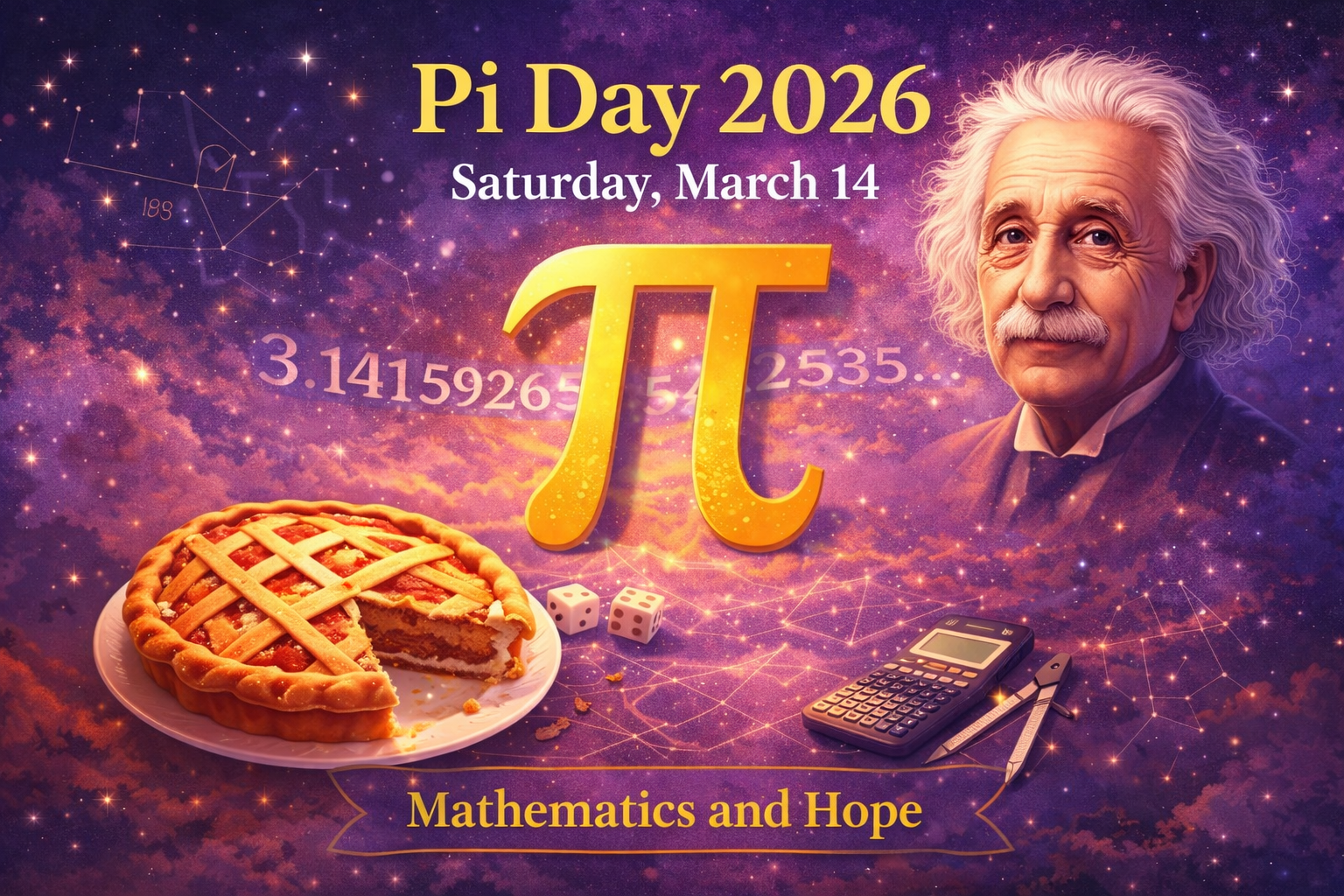
Today — Saturday, March 14, 2026 — the world celebrates one of the most delightfully nerdy holidays on the calendar: Pi Day. Every year on March 14 (written as 3/14 in the US date format), mathematics lovers, students, teachers, scientists, and pie enthusiasts around the globe come together to honour the most famous — and most infinite — number in history: π (pi).
Whether you’re a maths geek who can recite 50 digits of pi from memory, a student who first encountered π in a geometry class, or someone who simply loves a good excuse to eat pie — Pi Day 2026 has something for everyone. And this year carries extra meaning: it falls on a Saturday, Einstein’s birthday is being celebrated around the world, and the 2026 theme of “Mathematics and Hope” ties the beauty of numbers to solving humanity’s greatest challenges.
In this post, we cover everything you need to know: what pi actually is, the full history of Pi Day, this year’s theme, the most surprising pi facts, how people celebrate worldwide, and why today also happens to be one of the most significant days in science history.
- What Is Pi (π)? The Number That Never Ends
- When Is Pi Day 2026? Date & Why March 14
- Pi Day 2026 Theme: “Mathematics and Hope”
- History of Pi Day: From Larry Shaw to the UN
- Pi Day & Albert Einstein’s Birthday
- 10 Mind-Blowing Pi Facts You Didn’t Know
- How to Celebrate Pi Day 2026
- Where Does Pi Show Up in Real Life?
- Pi Day in India — Srinivasa Ramanujan Connection
- Frequently Asked Questions
🔢 What Is Pi (π)? The Number That Never Ends
Pi (π) is one of mathematics’ most extraordinary constants. Simply put, it is the ratio of any circle’s circumference to its diameter. No matter how large or small the circle — from a coin to a planet — if you divide its circumference by its diameter, you will always get the same answer: approximately 3.14159.
What makes pi remarkable is not just this elegant geometric property, but its infinite, non-repeating decimal expansion. Pi begins at 3.14159265358979… and continues forever without settling into any repeating pattern. It is what mathematicians call an irrational number — it cannot be expressed as a simple fraction — and also a transcendental number, meaning it is not the solution to any polynomial equation with rational coefficients.
“Divide any circle’s circumference by its diameter — whether for a pie plate or a planet — and the answer is always approximately 3.14.” — Exploratorium, San Francisco
Pi has now been calculated to more than 50 trillion decimal places — and mathematicians are still going. Despite all that computing power, not a single repeating pattern has ever been found.
📅 When Is Pi Day 2026? Why March 14?
Pi Day 2026 is on Saturday, March 14, 2026. The date was chosen because in the month/day format used in the United States, March 14 is written as 3/14 — which corresponds directly to the first three digits of pi: 3.14.
The celebration traditionally peaks at 1:59 PM — because 3.14159 are the first six digits of pi, and 1:59 extends the approximation to the fifth decimal place. Hardcore pi enthusiasts also mark 9:26:53 AM and PM as “Pi Moment”, when the date and time together represent the first ten digits of π (3.141592653).
- 📅 Date: Saturday, March 14, 2026
- ⏰ Pi Moment: 1:59 PM — first 6 digits of π (3.14159)
- 🎯 Ultimate Pi Moment: 9:26:53 — first 10 digits (3.141592653)
- 🌍 Alternative celebration: Pi Approximation Day — July 22 (22/7 ≈ π)
🌍 Pi Day 2026 Theme: “Mathematics and Hope”
Pi Day is not just a fun holiday — it is also the International Day of Mathematics (IDM), designated by UNESCO at its 40th General Conference in November 2019. Every year, the IDM adopts a global theme to focus public attention on how mathematics shapes the world.
The theme for Pi Day 2026 / International Day of Mathematics 2026 is “Mathematics and Hope”. According to LatestLY, this year’s theme explores how mathematics serves as a foundation for addressing humanity’s most urgent challenges — from climate change modelling and disease prediction to economic development and artificial intelligence. Traditions for 2026 include pie-eating, recitation contests, and global webinars on mathematics’ role in solving world challenges.
The theme is a reminder that behind every vaccine development, every climate forecast, every bridge design, and every algorithm on your phone — there is mathematics working quietly at the foundation.
📖 History of Pi Day: From Larry Shaw to the United Nations
Pi Day’s origins are surprisingly recent. Despite humans knowing about pi for nearly 4,000 years, the holiday itself is only 38 years old.
1988 — Larry Shaw Starts It All
The first organised Pi Day celebration took place on March 14, 1988, at the Exploratorium science museum in San Francisco, founded by physicist Larry Shaw. Shaw envisioned a fun way to make mathematics relatable and accessible. The initial event featured museum staff and members of the public marching in circular parades and eating fruit pies. The Exploratorium continues to hold its annual Pi Day celebration to this day — in 2026, they are hosting their 39th anniversary event on March 14, 11:00 AM – 4:30 PM, complete with a Pi Procession, live music, and free pie for parade participants.
2009 — US Congress Makes It Official
On March 12, 2009, the US House of Representatives passed a non-binding resolution (111 H. Res. 224), officially recognising March 14 as National Pi Day — making the United States the first country to formally acknowledge the holiday.
2015 — “Super Pi Day”
March 14, 2015 was celebrated as Super Pi Day because the date written as 3/14/15 captured the first five digits of pi (3.1415). At precisely 9:26:53 AM, the date and time together represented the first ten digits: 3.141592653 — a once-in-a-century alignment that won’t happen again until 2115.
2019 — UNESCO Elevates It Globally
At UNESCO’s 40th General Conference, Pi Day was designated the International Day of Mathematics — transforming it from a quirky American holiday into a globally recognised celebration of mathematical science and education.
The Ancient History of Pi Itself
While the holiday is modern, the number it celebrates is ancient. According to National Day Calendar, the concept of pi has been understood for nearly 4,000 years — the ancient Egyptians and Babylonians were already using accurate approximations of pi as far back as 2000 BC to build structures. Greek mathematician Archimedes made the first rigorous mathematical calculation of pi around 250 BC. And in 1706, Welsh mathematician William Jones was the first to use the Greek letter π to represent the ratio — a symbol later popularised by the great mathematician Leonhard Euler.
🎂 Pi Day & Albert Einstein’s Birthday — A Beautiful Coincidence
One of the most delightful facts about Pi Day is that it coincides with the birthday of Albert Einstein, born on March 14, 1879, in Ulm, Germany. Einstein lived in Princeton, New Jersey for more than twenty years while working at the Institute for Advanced Study — and Princeton has turned this happy coincidence into one of the world’s most elaborate Pi Day celebrations, featuring an annual Einstein look-alike contest alongside pie-eating and recitation competitions.
Pi Day 2026 also marks the 8th anniversary of the passing of physicist Stephen Hawking, who died on March 14, 2018. The day has therefore become, in the minds of many science enthusiasts, a broader tribute to the greatest scientific minds in history — connecting the elegance of mathematics with the wonder of physics and cosmology.
| March 14 Milestone | Year | Significance |
|---|---|---|
| Albert Einstein born | 1879 | Father of relativity; Theory of General & Special Relativity |
| First Pi Day celebrated | 1988 | Larry Shaw, Exploratorium, San Francisco |
| US National Pi Day recognised | 2009 | US House of Representatives, H. Res. 224 |
| Super Pi Day (3/14/15) | 2015 | First 5 digits of pi in date format; won’t repeat until 2115 |
| Stephen Hawking passed away | 2018 | Theoretical physicist; author of A Brief History of Time |
| UNESCO: International Day of Mathematics | 2019 | Pi Day goes global under UNESCO recognition |
| Pi Day 2026 | 2026 | Theme: “Mathematics and Hope” | Einstein’s 147th birthday | Saturday |
🤯 10 Mind-Blowing Pi Facts for Pi Day 2026
- Pi has been calculated to over 50 trillion decimal places — and not a single repeating pattern has ever appeared. According to University of Cincinnati mathematics professor Michael Goldberg, pi is truly infinite with zero discernible structure.
- The world record for memorising pi belongs to an Indian. In 2015, Rajveer Meena of India memorised 70,000 decimal places of pi — a feat certified by the Guinness World Records, as noted by National Day Calendar. He was blindfolded during the recitation, which took nearly 10 hours.
- Some mathematicians think we picked the wrong number. A vocal group of mathematicians argues that τ (tau) = 2π ≈ 6.283 is actually more fundamental than π, since it represents the ratio of a circle’s circumference to its radius (not diameter). UC professor Goldberg notes this is a genuine mathematical debate — not just a meme.
- Your birthday is almost certainly hidden inside pi. Because pi’s digits are believed to be statistically random and infinite, any finite sequence of numbers — including your birth date, phone number, or ID — is mathematically likely to appear somewhere in pi’s infinite expansion. Boston Today notes this is a common claim, though experts caution it hasn’t been formally proven.
- Pi was used by the ancient Egyptians to build pyramids. By 2000 BC, both Egyptians and Babylonians were using accurate approximations of pi in their construction — thousands of years before it was formally defined, according to National Day Calendar.
- Archimedes’ method for calculating pi was remarkably accurate. Around 250 BC, the Greek mathematician Archimedes approximated pi by inscribing and circumscribing polygons around a circle — reaching an estimate between 3.1408 and 3.1429. Not bad for 250 BC.
- The symbol π was first used in 1706. Welsh mathematician William Jones introduced the symbol π in 1706. It was later popularised by the Swiss mathematician Leonhard Euler, and has been the standard notation ever since, as noted in the Pi Day Wikipedia entry.
- Pi shows up in probability and statistics — not just geometry. The famous Buffon’s Needle problem (tossing a needle onto a ruled surface) can be used to statistically estimate pi — a beautiful bridge between geometry and chance. The Exploratorium even hosts this as an interactive Pi Day activity.
- Pi is irrational AND transcendental. Being irrational means it can’t be expressed as a fraction. Being transcendental is rarer — it means pi is not a root of any non-zero polynomial equation with rational coefficients. Only a handful of famous constants share both properties.
- Pi Day is also Pi Minute and Pi Second. On March 14 at 1:59:26 AM/PM, the date and time together read 3.1415926 — aligning seven digits of pi simultaneously. This is known as “Pi Minute”, and is celebrated with particular enthusiasm by mathematicians worldwide.
🥧 How to Celebrate Pi Day 2026
Pi Day is one of those rare occasions that manages to make maths genuinely festive. Here are the most popular ways people around the world are celebrating on March 14, 2026:
🥧 1. Eat Pie (Obviously)
The most beloved Pi Day tradition is eating pie — because “pi” and “pie” are homophones, and because pies are beautifully circular. From apple pie and pumpkin pie to pizza pie and shepherd’s pie, any circular food qualifies. In the US, dozens of restaurant chains offer $3.14 deals on Pi Day every year — from pizza slices to whole pies.
🧮 2. Recite Pi Digits
Organise a pi recitation contest with friends, classmates, or family. Who can recall the most digits without making a mistake? The current world record holder, India’s Rajveer Meena, set the bar at an extraordinary 70,000 digits. Even getting to 20 or 30 digits is an impressive party trick.
🎉 3. Attend a Pi Day Event
The Exploratorium in San Francisco is hosting its 39th annual Pi Day celebration today (March 14, 2026, 11:00 AM – 4:30 PM) with a Pi Procession, math activities, and free pie. The University of Cincinnati is hosting Pi-themed challenges, inflatables, and activities at Clark Montessori High School’s Cafetorium. Schools, science museums, and colleges worldwide are hosting similar events today.
📚 4. Learn Something New About Maths
Pi Day is a perfect excuse to dive into mathematical topics you’ve always been curious about — from the history of calculus to how AI uses linear algebra. Free resources like Khan Academy and Wolfram Alpha make this easier than ever.
🎨 5. Get Creative with Pi Art
Pi has inspired an entire genre of “pi art” — visual representations of its digits as colours, music as notes, or shapes. Try creating your own pi-inspired pattern or look up some of the stunning mathematical art that pi has generated online.
🌐 6. Participate in the International Day of Mathematics
Since Pi Day is also the International Day of Mathematics, check for global webinars, online lectures, and digital events focusing on this year’s theme of “Mathematics and Hope”. These events are free and open to learners of all ages worldwide.
⚙️ Where Does Pi Show Up in Real Life?
Pi is not just an abstract curiosity — it is one of the most practically useful constants in all of science and engineering. Here’s where you encounter it every day without realising it:
- Architecture & Construction: Any dome, arch, or circular structure — from the Pantheon in Rome to a modern water tank — is designed using pi. Calculating the area of a circle (πr²) and the circumference (2πr) are fundamental to building anything round.
- Astronomy: Pi is essential for calculating the orbits of planets, the size of stars, and the distances between celestial objects. NASA uses pi extensively in trajectory calculations for spacecraft missions.
- Physics & Engineering: Pi appears in wave equations, quantum mechanics, the physics of pendulums, and electrical engineering. The famous Fourier transform — used in everything from MRI machines to music streaming compression — is full of pi.
- GPS Technology: The algorithms that calculate your precise location on Earth rely on pi for spherical geometry and coordinate transformations.
- Statistics & Probability: The normal distribution (the famous bell curve used in everything from exam scores to stock prices) contains pi directly in its formula.
- Computer Graphics: Every circle, sphere, cylinder, or rounded corner in a video game or 3D animation is rendered using pi.
As Boston Today notes, Pi Day provides an opportunity to engage the public with how mathematical concepts have practical applications in fields from construction to astronomy — and how they have captivated human curiosity for millennia.
🇮🇳 Pi Day in India — The Ramanujan Connection
India has a profound and proud connection to the history of pi and mathematics. Srinivasa Ramanujan (1887–1920), one of the greatest mathematical geniuses in history, developed several extraordinarily efficient formulas for calculating pi — some of which remain the basis for modern computer algorithms used to extend pi’s known digits today.
India celebrates National Mathematics Day on December 22 — Ramanujan’s birthday — honouring his extraordinary contributions. But Pi Day on March 14 is increasingly being observed in Indian schools, colleges, and science institutions as part of the UNESCO International Day of Mathematics.
The world record for pi memorisation also belongs to India: Rajveer Meena, from Vellore Institute of Technology, recited 70,000 digits of pi in 2015 — blindfolded, over nearly 10 hours — a feat that remains unchallenged. India’s connection to pi is not just historic — it is record-breaking.
❓ Frequently Asked Questions — Pi Day 2026
When is Pi Day 2026?
Pi Day 2026 is on Saturday, March 14, 2026. It is celebrated every year on March 14 (3/14) because 3, 1, and 4 are the first three significant digits of the mathematical constant pi (π ≈ 3.14159).
What is the theme of Pi Day 2026?
The theme of Pi Day 2026 / International Day of Mathematics 2026 is “Mathematics and Hope”. The theme highlights mathematics’ role as a foundation for solving global challenges including climate change, disease, and sustainable development.
Why is March 14 celebrated as Pi Day?
March 14 is celebrated as Pi Day because in the US date format (month/day), it is written as 3/14 — which corresponds to the first three digits of pi: 3.14. Pi Day was founded in 1988 by Larry Shaw at the Exploratorium in San Francisco, and has since become an international holiday recognised by UNESCO.
What is pi (π) in maths?
Pi (π) is the ratio of a circle’s circumference to its diameter. Its value is approximately 3.14159265358979… — an irrational, transcendental number that continues infinitely without repeating. It has been calculated to over 50 trillion decimal places.
Whose birthday is on Pi Day?
Pi Day coincides with the birthday of Albert Einstein, who was born on March 14, 1879. It is also the anniversary of the death of physicist Stephen Hawking, who passed away on March 14, 2018.
Who holds the world record for memorising pi?
India’s Rajveer Meena holds the Guinness World Record for memorising pi — reciting 70,000 decimal places in 2015, while blindfolded, in a session that lasted nearly 10 hours.
Is Pi Day today?
Yes! Today, March 14, 2026, is Pi Day — the annual celebration of the mathematical constant π. Happy Pi Day! 🥧
How is Pi Day celebrated?
Pi Day is celebrated through pie-eating, pi recitation contests, math-themed events, school activities, circular parades, and food deals at restaurants. The Exploratorium in San Francisco holds an annual Pi Procession. Globally, it is marked as the International Day of Mathematics with lectures, webinars, and educational events focused on the year’s theme.
🥧 Happy Pi Day 2026!
Whether you celebrate by eating a slice of pie, challenging yourself to recite digits, watching a maths lecture, or simply appreciating the perfect circular shape of a pizza — Pi Day 2026 is a reminder that mathematics is not just a school subject. It is the language in which the universe is written.
From the ancient Egyptians measuring their pyramids, to Archimedes’ clever geometric proofs, to Ramanujan’s brilliant infinite series, to today’s supercomputers computing trillions of digits — the pursuit of pi is one of humanity’s longest, most beautiful intellectual journeys.
And today, it continues. Happy Pi Day 2026! 🎉 π = 3.14159265…
📅 Date: Saturday, March 14, 2026
🎯 Theme: “Mathematics and Hope”
🎂 Also: Albert Einstein’s 147th birthday
🏆 Pi Record: Rajveer Meena (India) — 70,000 digits
🏛️ Founded: 1988, Exploratorium, San Francisco
🌍 Global observance: UNESCO International Day of Mathematics
♾️ Pi so far: 3.14159265358979323846264338327950288…
Comments
Leave a comment